
Struggling with products that require both hard and soft materials? The assembly process is often slow, expensive, and results in parts that can easily break apart. This is a common frustration.
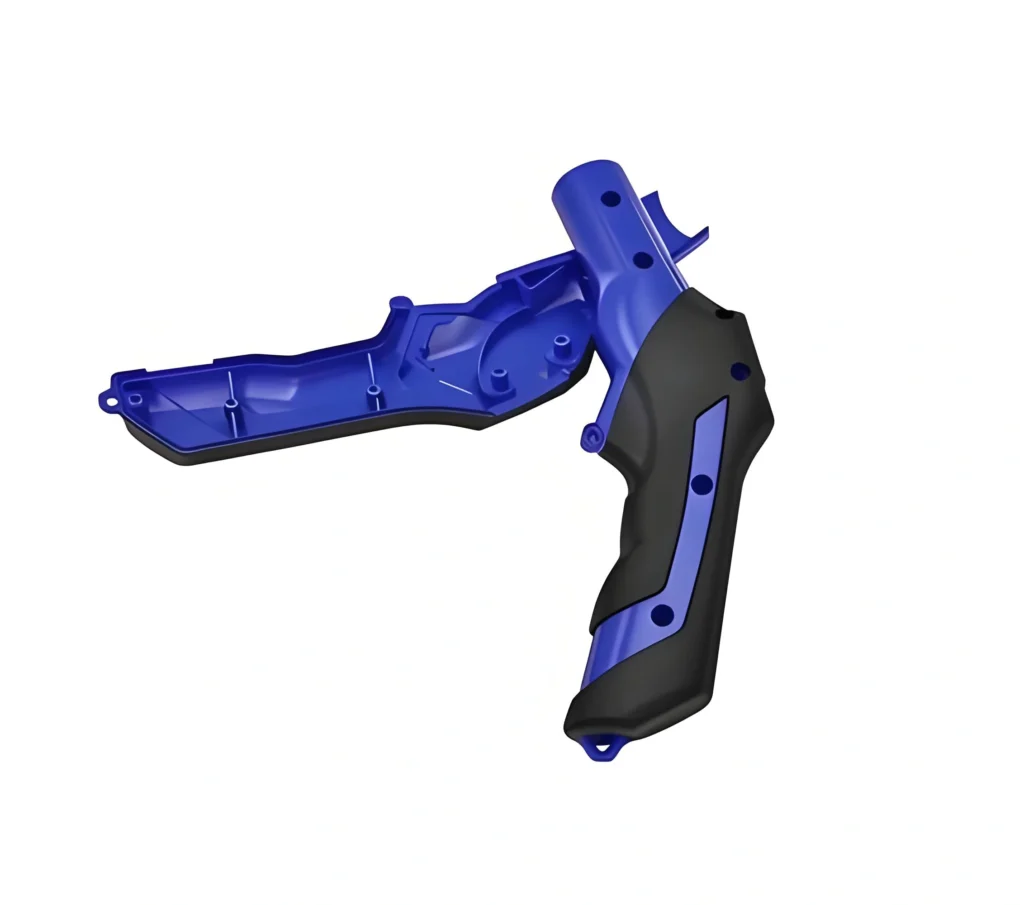
Over injection molding, also known as overmolding, is a process where one material (usually a soft thermoplastic) is molded onto a second material (a hard substrate). This creates a strong chemical bond1, resulting in a single, durable part with multiple material properties, like a soft grip on a hard handle.

I've been in the custom mold manufacturing business for over 15 years, and I've seen countless projects transformed by this technique. It’s more than just sticking two pieces together; it’s about creating a truly integrated product2 from the start. Many clients, especially those developing new electronics or automotive parts3, come to us thinking they need complex assembly lines. They are often surprised when we show them how overmolding can achieve a better result in a fraction of the time. It’s a game-changer for both product quality4 and production efficiency5. Let's explore how this process can benefit your project.
How does over injection molding6 actually work?
Confused about how two different plastics can become one seamless part? The technical details seem complex, and you might worry about whether the materials will truly bond together permanently.
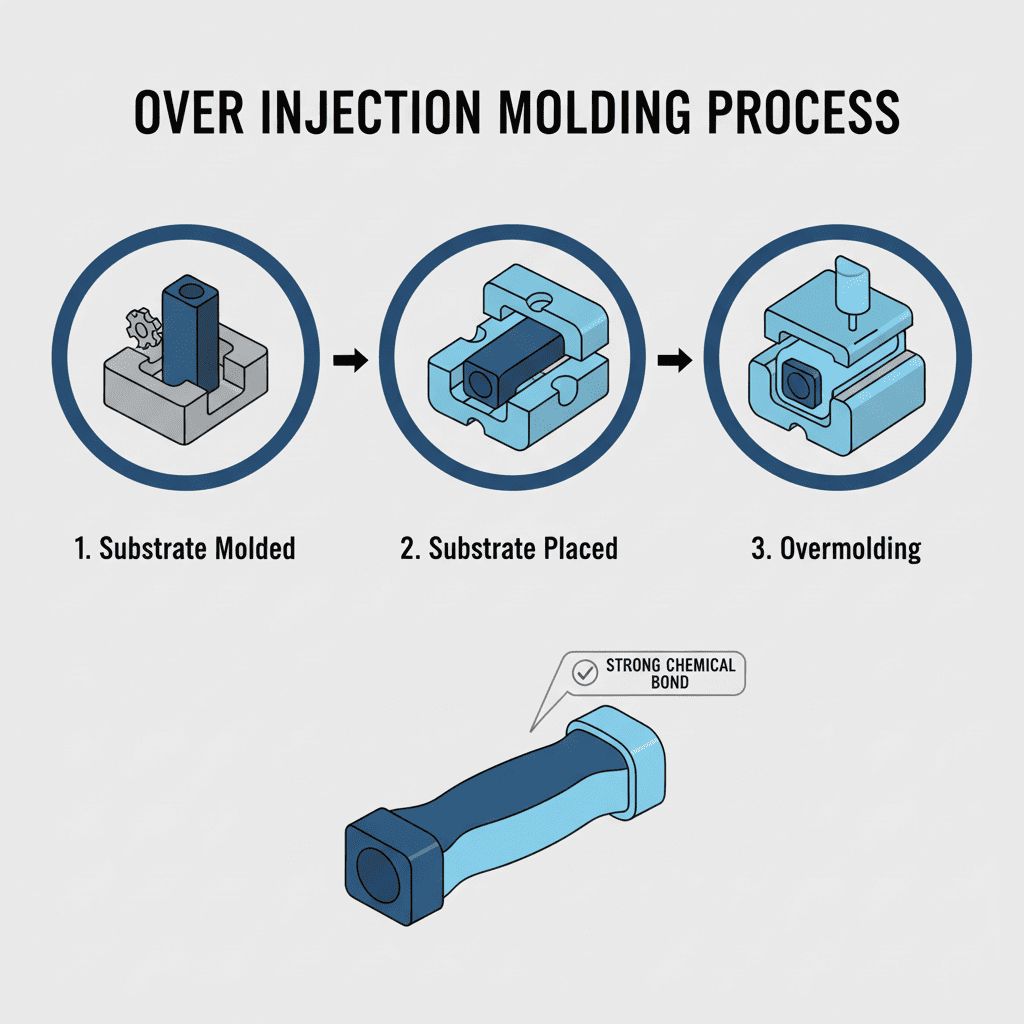
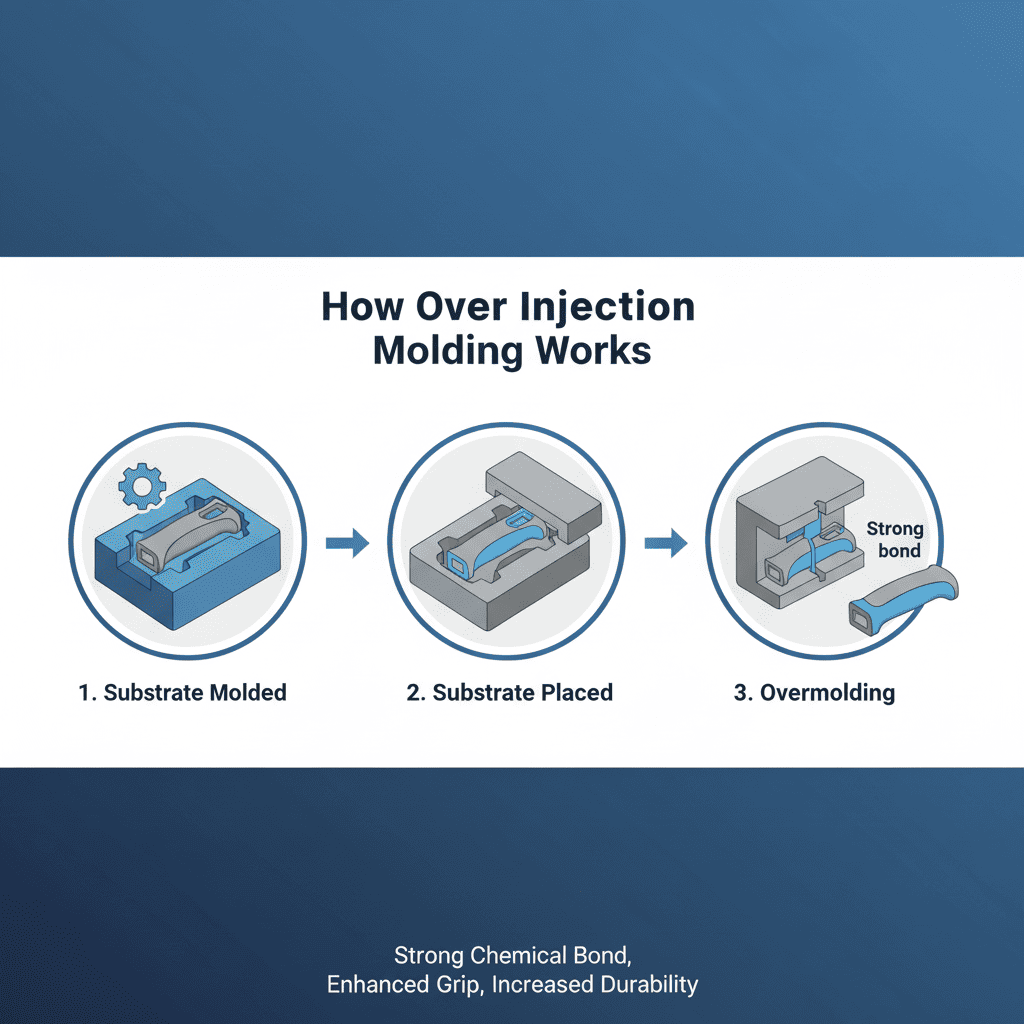
The process involves two main steps. First, we inject the hard base part, called the substrate. Then, we place that substrate into another mold cavity and inject the second, softer material directly onto it. The heat and pressure create a permanent chemical bond between the two materials.
Let's dive deeper into the mechanics. The success of this entire process depends on a few critical factors that we manage very carefully. It's a precise science, not just a simple two-shot process.
The Two-Step Injection Cycle
First, we create the substrate. This is the rigid, structural part of your product. We inject a plastic like ABS or PC into a custom-made mold. Once it cools and solidifies, we move to the next step. Sometimes, we use a robotic arm to transfer the hot substrate immediately into the second mold cavity. This keeps the substrate surface at an optimal temperature for bonding. In other cases, we might mold the substrates in a large batch and then overmold them later.
The Importance of Material Synergy
The second step is injecting the overmold material, often a TPE (Thermoplastic Elastomer7). The real magic happens here. The choice of materials is crucial. We must ensure they are chemically compatible. If they aren't, they won't form a strong, permanent bond. Think of it like trying to mix oil and water—it just doesn't work. We test for compatibility to ensure the materials will fuse together at a molecular level, not just stick together. This creates a bond that is far stronger than any glue or mechanical fastener.
Here’s a simple breakdown of what we consider:
| Critical Factor | Why It Matters | Our Approach at Ambition Industrial |
|---|---|---|
| Material Compatibility | Ensures a strong chemical bond. Incompatible materials will peel apart easily. | We help you select material pairs with proven compatibility, like PC and TPE, or ABS and TPU. |
| Mold Design | The mold must hold the substrate perfectly and guide the second material flow. | We design our molds with precision gating to prevent material mixing and ensure even layer thickness. |
| Injection Parameters | Temperature, pressure, and speed must be perfect for both materials. | We use advanced injection molding machines to control each parameter with an accuracy of ±0.05mm. |
What are the main benefits of using this process?
Worried that high production costs and weak product performance are hurting your brand? Assembling separate parts is slow, drives up labor costs, and often leads to products that fail.
Overmolding reduces costs and improves product quality4. It eliminates assembly steps, shortens production cycles8, and creates a much stronger bond between materials. This results in a more durable and reliable product, directly enhancing your brand’s reputation for quality and lowering warranty claims.
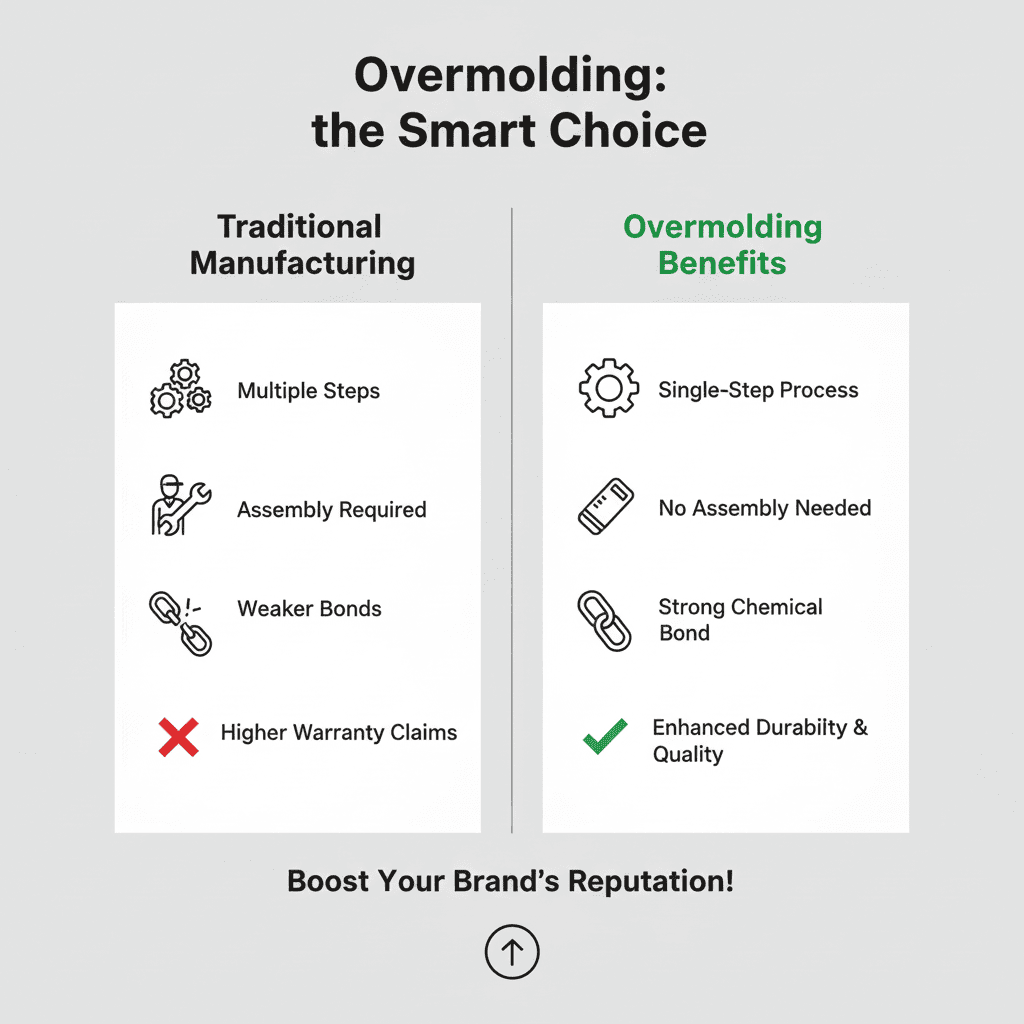
I remember working with a client who developed high-end educational toys. Their original design involved gluing soft rubber pads onto a hard plastic casing. They were dealing with high failure rates because the pads would peel off after just a few weeks of use by kids. It was a nightmare for their customer service department and their brand reputation. By switching to overmolding, we created a single, solid part where the soft pads were permanently bonded to the casing. Their product failure rate dropped to almost zero, and they saved a huge amount on assembly labor. It's a clear example of how this process delivers both functional and financial wins.
Cost and Efficiency Gains
The biggest advantage is creating an integrated part in one go. You skip entire steps in the production line. There is no need for manual or automated assembly to join two different components. You don't need to buy or apply adhesives. This directly translates to lower labor costs and a faster production cycle. When you are making thousands or millions of parts, this time and cost saving is enormous. It allows you to get your product to market faster and at a more competitive price point.
Superior Product Performance and Durability
The bond created during overmolding is not just mechanical; it’s chemical. The materials fuse together. This is much stronger and more reliable than a glued or snap-fit connection. For products that are handled frequently, like power tools or electronic devices, this is critical. It means the soft grip won't peel away from the hard handle. It also provides a natural seal against dust and water, improving the product's overall lifespan and performance. This durability is something customers notice, and it builds trust in your brand. You spend less on warranty replacements and build a reputation for making things that last.
What are the best applications for over injection molding6?
Wondering if overmolding is right for your specific product? It's easy to see the benefits, but it can be hard to know where this technology truly shines and adds the most value.
Overmolding is ideal for any product that needs both structural integrity and a soft, functional surface. Think of consumer electronics9 with non-slip grips, automotive parts3 with soft-touch buttons, or medical devices10 that require a comfortable, sealed handle. It combines function and cost-efficiency.
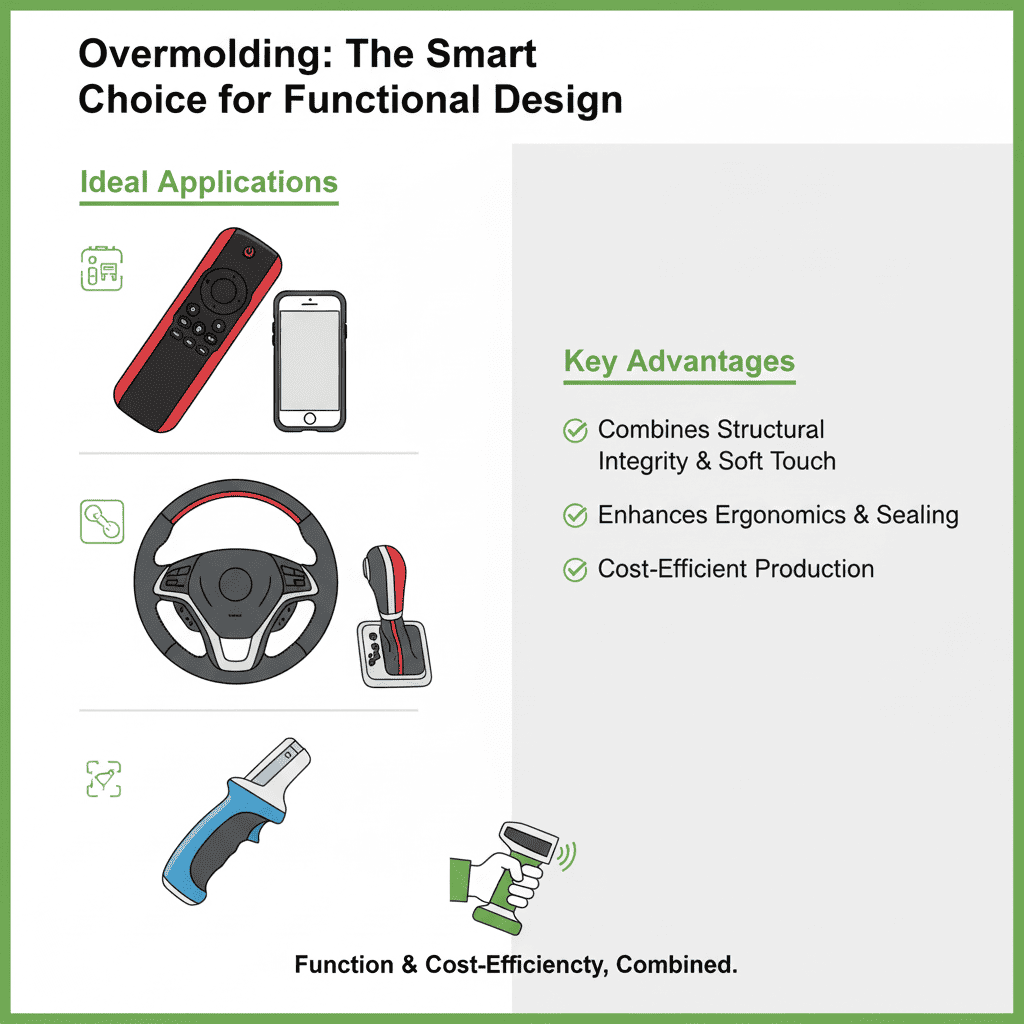
We work with clients across many industries, and the logic for using overmolding is almost always the same: they need to add a functional feature to a structural part without adding complexity or cost. For an automotive client, we developed interior door handles that had a hard, durable base with a soft, premium-feeling grip layer. For a toy developer, we created STEM robot parts11 with integrated soft wheels for better traction. In both cases, the goal was to add value—a better user experience12 or improved performance—in the most efficient way possible. The technology is incredibly versatile.
Common Industry Examples
The applications are everywhere once you start looking. The core idea is to combine "structure + function" in a single component.
-
Consumer Electronics: Think about your smartphone case. Many have a rigid polycarbonate (PC) frame for protection and a soft thermoplastic polyurethane (TPU) outer layer for grip and shock absorption. This is a classic use of overmolding. It provides two functions in one slim, integrated design.
-
Automotive Industry: Look inside any modern car. The steering wheel, dashboard knobs, and window controls often feature a hard plastic base with a soft, tactile surface. This not only feels more luxurious but also improves grip and usability. Overmolding is essential for creating these durable, high-quality interior components.
-
Medical Devices: Surgical tools, diagnostic devices, and even personal health monitors need to be both durable and ergonomic. A hard, sterilizable plastic handle with a soft, non-slip grip makes the device safer and more comfortable for doctors and patients to use. The seamless design also prevents germs from getting trapped in cracks, which is a major benefit.
-
Household Goods and Tools: The handle on your toothbrush, the grip on your power drill, or the soft lining on your kitchen utensils are all perfect examples. Overmolding adds comfort, control, and safety to everyday products, making them better for the end-user.
Conclusion
Over injection molding is a powerful manufacturing process that fuses different materials into one part. It cuts costs, boosts product quality, and unlocks new design possibilities for your projects.
Understand the science behind chemical bonding in overmolding and why it matters for product integrity. ↩
Understand the concept of integrated products and how overmolding achieves this. ↩
Discover how overmolding is revolutionizing the automotive industry with innovative designs. ↩
Learn how overmolding contributes to superior product quality and customer satisfaction. ↩
Find out how overmolding streamlines production processes and reduces costs. ↩
Explore this resource to understand the fundamentals of over injection molding and its applications. ↩
Learn about Thermoplastic Elastomers and their critical role in creating flexible, durable products. ↩
Find out how overmolding can significantly reduce production time and increase output. ↩
Explore the applications of overmolding in consumer electronics for improved functionality. ↩
Learn about the critical applications of overmolding in creating safe and ergonomic medical devices. ↩
Discover how overmolding is used in educational toys and robotics for enhanced performance. ↩
Learn how overmolding improves user experience through better design and functionality. ↩