
Are you struggling to choose between POM and nylon for your project? They seem similar, but picking the wrong one can cause failures. Let’s clear up the confusion for good.
No, POM is not the same as nylon. They are two distinct engineering plastics1. POM (Polyoxymethylene) is a polyacetal prized for its high rigidity, low friction, and excellent dimensional stability. Nylon (Polyamide) is known for its incredible toughness2, impact resistance, and flexibility.


It's easy to see why people get them mixed up. Both are strong, durable, and often used in similar-looking mechanical parts3. At Ambition Industrial, we work with both materials every day, and I've seen firsthand how a simple mix-up can lead to big problems down the line. But once you understand their unique personalities, you'll see they are built for very different jobs. Let's break down exactly what sets them apart, so you can choose with confidence every single time.
What really separates POM and Nylon at a chemical level?
Struggling with the technical jargon behind plastics? Chemical names can be confusing, and this might lead to overlooking critical material properties. You need to know the basics to make a smart choice.
POM, or polyoxymethylene, is a linear polyacetal polymer. Nylon, or polyamide, belongs to a family of polymers linked by amide bonds. This fundamental chemical difference dictates all their physical properties, from how they handle moisture to their overall strength and application suitability.
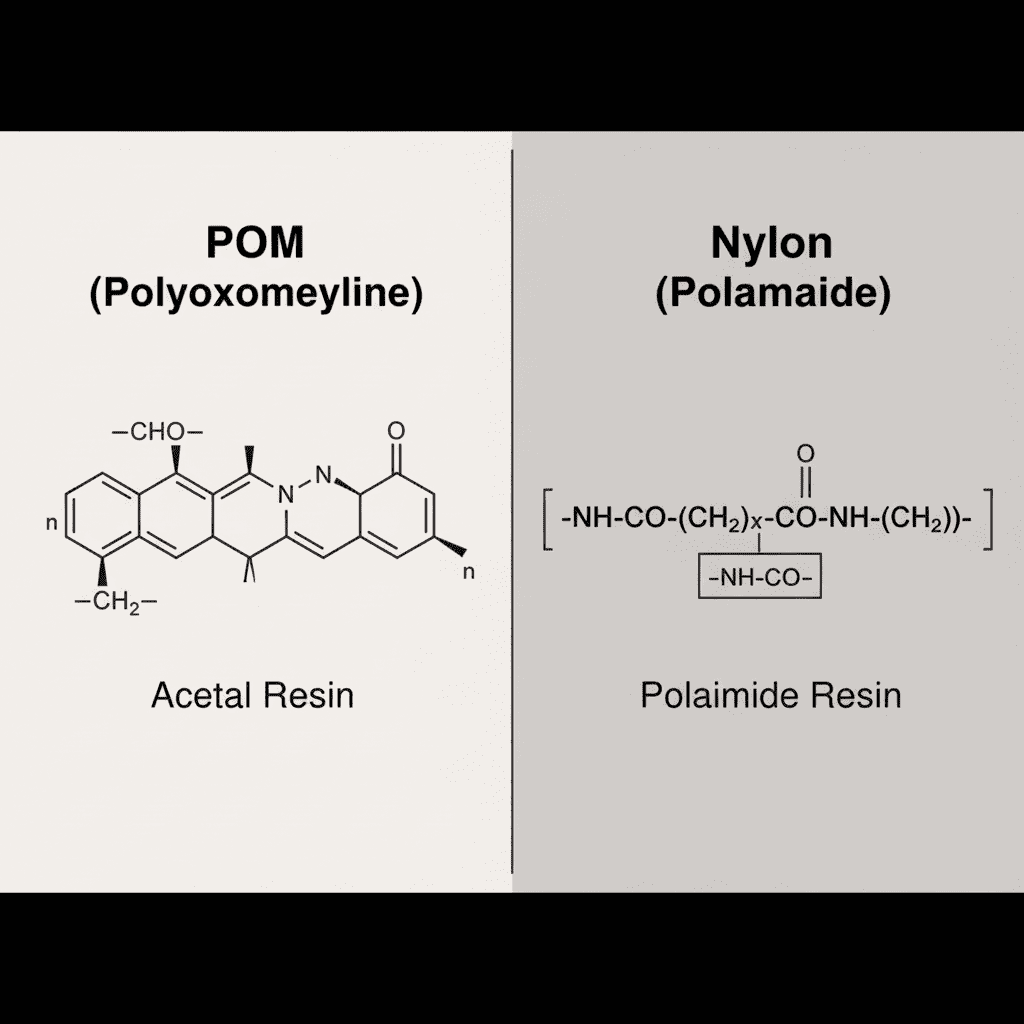
Let’s dive a little deeper without getting too lost in the science. Think of polymers as long chains made of repeating building blocks. The type of building block and how the chains are arranged defines the plastic. For POM, its simple, repeating chain creates a very orderly, crystalline structure. This is why POM is so rigid, dimensionally stable, and has a naturally slippery surface. In our factory, this translates to very predictable and precise injection molding. We can hold tight tolerances, like ±0.05mm, because the material doesn’t warp or change shape much as it cools.
Nylon is different. Its polyamide chains have hydrogen bonds between them. These bonds act like tiny magnets, holding the chains together tightly, which gives nylon its amazing toughness and resistance to impact. However, these same bonds also love to attract water molecules. This makes nylon "hygroscopic," meaning it absorbs moisture from the air. We once had a client developing an electronic enclosure for a tropical market. They initially considered nylon for its strength, but we advised against it. The high humidity would cause the nylon parts to swell, potentially damaging the internal electronics. We switched to POM, which resists moisture, and the product was a success.
Key Chemical Differences
| Feature | POM (Polyoxymethylene) | Nylon (Polyamide) |
|---|---|---|
| Chemical Family | Polyacetal | Polyamide |
| Key Bond | Acetal Linkage (-O-CH2-O-) | Amide Linkage (-CO-NH-) |
| Molecular Structure | Highly Crystalline | Semi-Crystalline |
| Water Interaction | Hydrophobic (Resists Water) | Hydrophilic (Absorbs Water) |
How do their physical properties affect your product's performance?
Worried your plastic parts will wear out, break, or change shape? Choosing a material without understanding its core strengths can doom a project. You need a material that performs reliably under real-world stress.
The key difference lies in rigidity versus toughness. POM is extremely rigid and slippery, making it a champion of wear resistance4 and low friction5. Nylon is tough and resilient, meaning it can absorb impacts and bend without breaking, making it ideal for parts that face sudden shocks.
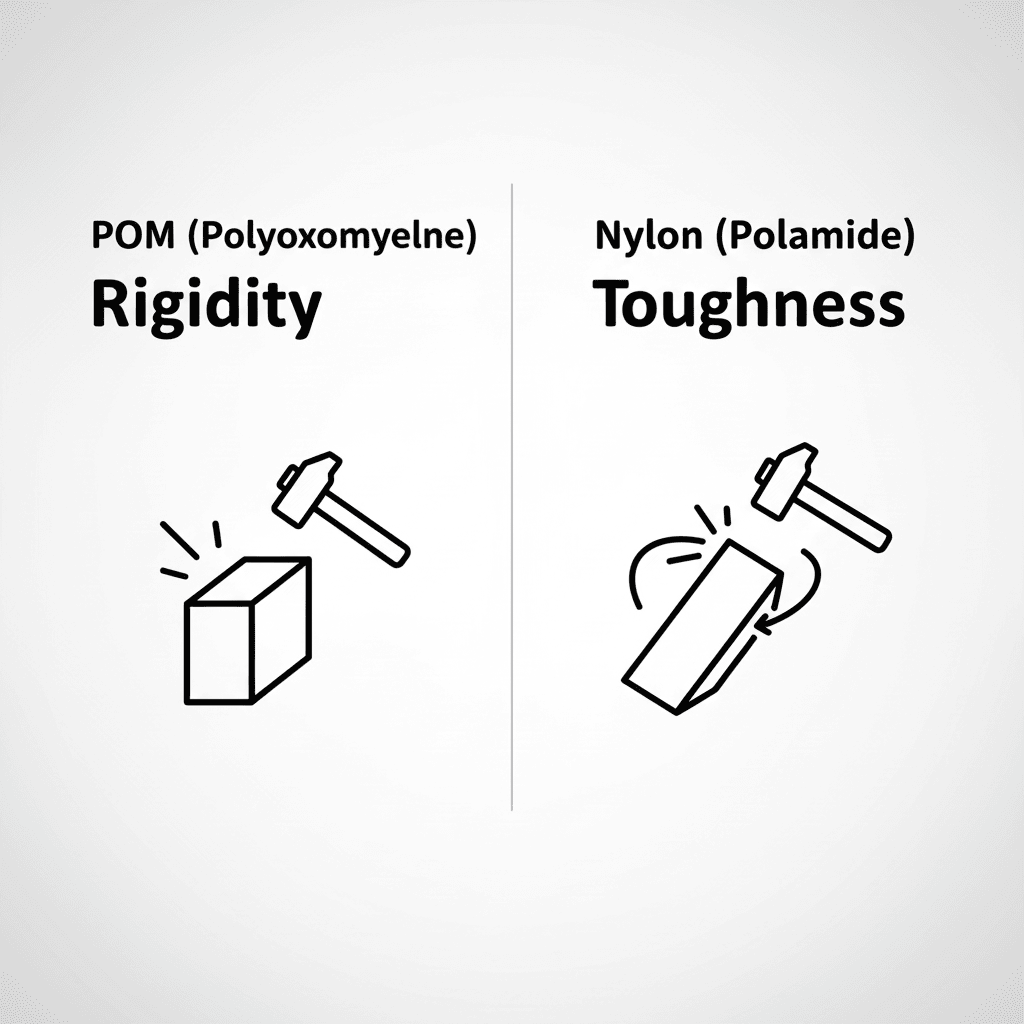
Think of it this way: POM is like a suit of armor, while nylon is like a leather jacket. The armor is incredibly hard and protects against steady, grinding wear, but a powerful, sharp blow could crack it. The leather jacket can take a punch, absorb the force, and bounce back, but it will scuff and wear down over time from constant rubbing.
In our manufacturing work, this plays out in very practical ways. For a client developing high-end educational toys with complex gearboxes, we exclusively use POM for the gears. Why? Because the gears need to mesh perfectly and run smoothly for thousands of cycles without wearing down. The dimensional stability of POM ensures the toy operates flawlessly over its lifetime.
On the other hand, for a customer in the automotive industry, we use nylon to make clips and fasteners for interior panels. These parts need to be tough enough to survive the assembly line, where they are snapped into place with force. They also need to absorb vibrations from the road without rattling or breaking. POM would be too brittle for this job; it would likely crack under the installation pressure. Nylon’s flexibility and impact strength are perfect for this kind of application.
Performance Head-to-Head
| Property | POM (Acetal) | Nylon (Polyamide) |
|---|---|---|
| Primary Strength | Rigidity, Low Friction, Wear Resistance | Toughness, Impact Resistance, Flexibility |
| Dimensional Stability | Excellent (resists warping) | Fair (can swell with moisture) |
| Friction | Very Low (self-lubricating6) | Low |
| Impact Strength | Moderate | Excellent |
| Typical Hardness | High (Rockwell M94) | Medium-High (Rockwell R120) |
Which material is right for your specific application?
Are you unsure which plastic will guarantee your product's success? Making the wrong choice can lead to costly redesigns and product recalls. You need to match the material's strengths directly to your application's demands.
Choose POM for precision mechanical parts3 that require low friction and stability, like gears, bearings, and sliders. Choose nylon for structural components that need to withstand impacts and vibration, such as housings, fasteners, and flexible tubing. Making the right call depends entirely on the job.
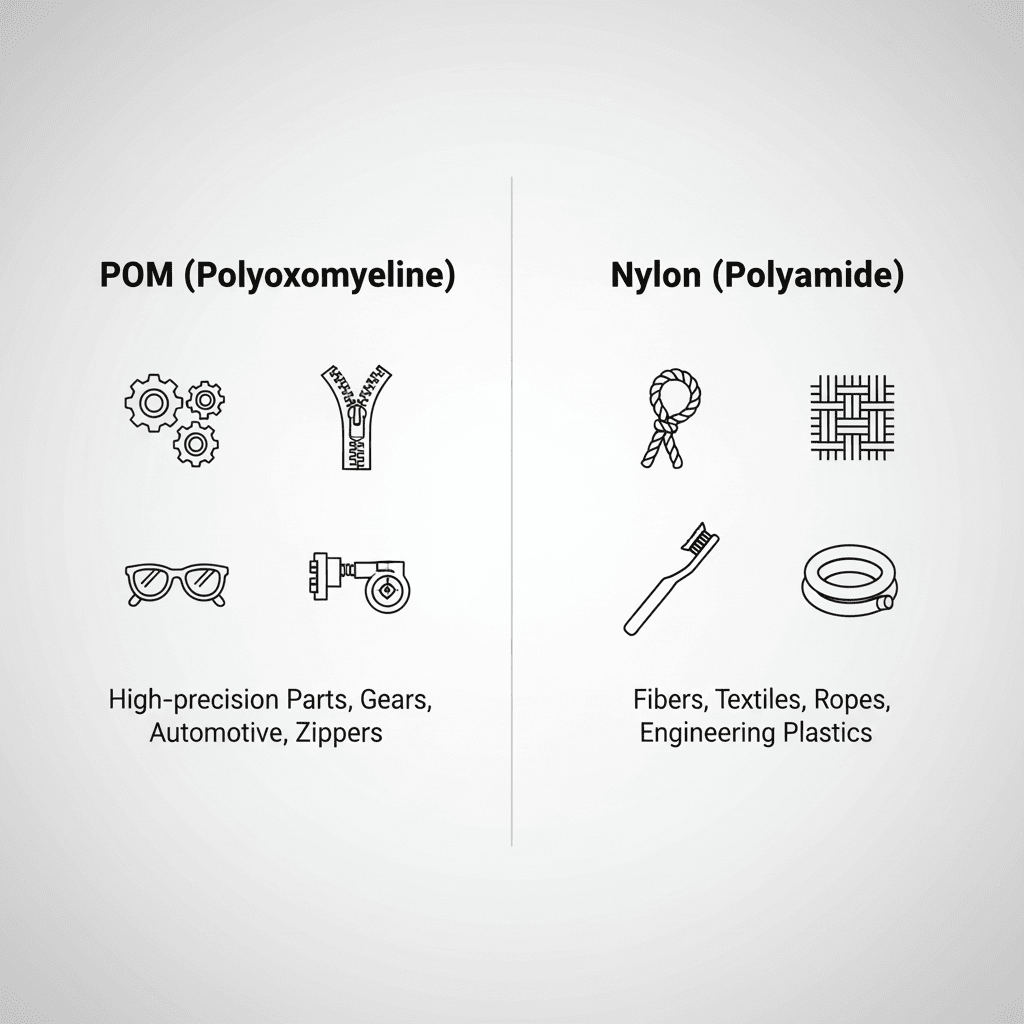
Let’s walk through some real-world examples from our clients. A developer of high-end cosmetic packaging came to us for a new lipstick mechanism. The part needed to twist smoothly and consistently, providing a premium feel. It also had to maintain its exact dimensions to prevent the lipstick from jamming. POM was the obvious choice. Its low friction meant no lubricant was needed, and its dimensional stability ensured a perfect fit and function every time.
Conversely, we work with a company that makes parts for car interiors. They needed to produce snap-fit connectors that hold door panels in place. These connectors are subjected to force during installation and constant vibration when the car is moving. Nylon was the clear winner here. Its superior toughness meant it wouldn’t break when snapped into place, and its ability to absorb energy prevented any annoying rattles for the driver. Using a brittle material like POM would have been a disaster; the clips would have failed during assembly. By understanding the application's core requirements—precision movement versus impact absorption—we guide our clients to the perfect material, ensuring their products are reliable and successful.
Application Quick Guide
| Industry / Product | Recommended Material | Why? |
|---|---|---|
| Automotive (Gears, Fuel Caps) | POM | Chemical resistance, low friction, and dimensional stability. |
| Automotive (Enclosures, Clips) | Nylon | High impact strength, vibration damping, and toughness. |
| Consumer Electronics | POM | Precision parts like sliders and small gears need stability. |
| Industrial Machinery | POM (Bearings, Rollers) | Excellent wear resistance4 and self-lubricating properties. |
| Power Tools (Housings) | Nylon | Needs to withstand drops and impacts without cracking. |
| Educational Toys (Gearboxes) | POM | Ensures smooth, long-lasting mechanical movement. |
Conclusion
In short, POM and nylon are not the same. POM offers rigidity and stability for precision parts, while nylon provides toughness and impact resistance for durable, structural components.
Discover the various types of engineering plastics and their applications in industry. ↩
Explore the concept of toughness and its importance in selecting materials for durability. ↩
Learn about the best materials for mechanical parts to ensure reliability and performance. ↩
Explore the significance of wear resistance in prolonging the life of mechanical components. ↩
Learn how low friction properties can enhance the performance of mechanical parts. ↩
Find out how self-lubricating properties can reduce maintenance and improve efficiency. ↩