Confused about which molding process to choose? The wrong decision can lead to costly errors and project delays. Let's break down the key differences between these two methods.
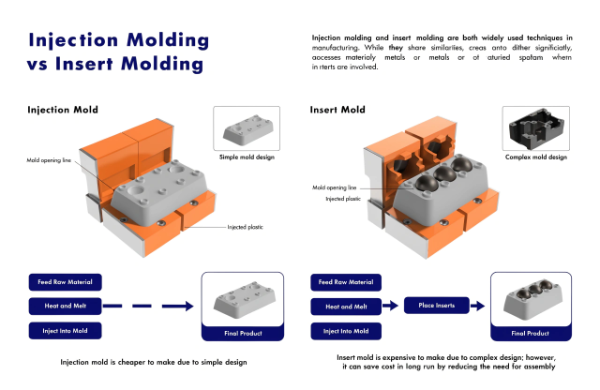
The primary difference lies in their output. An injection mold creates monolithic components from a single plastic material. In contrast, an insert mold is designed to combine prefabricated inserts, often metal, with molten plastic to produce integrated, multi-material composite parts directly from the mold.
Now you know the fundamental distinction. But this is just the tip of the iceberg. To truly make an informed decision for your project, you need to dig deeper into how this single difference impacts the process, applications, and overall cost. Let's explore these aspects so you can confidently select the right mold tooling for your product.
How do their core functions really differ?
Struggling to visualize the functional difference? It's easy to see them as similar, but their core purpose is fundamentally distinct, which impacts the final product's capabilities and design.
An injection mold’s function is straightforward: it shapes molten plastic into a finished part. An insert mold, however, has a dual function. It must first securely hold a separate component—the insert—and then use plastic forming to create a single, unified piece with that component.
To get a clearer picture, let's look at what each mold is built to do. The goal of a standard injection mold is to produce a large volume of identical, single-material parts efficiently. Think of simple plastic enclosures, bottle caps, or toy bricks. The entire part is formed from the plastic injected into the mold cavity.
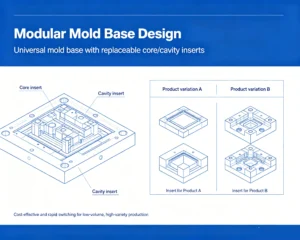
On the other hand, an insert mold is designed for creating composite parts. Its key job is to integrate different materials, like a metal screw thread into a plastic knob or a circuit board into a sensor housing. The mold has special features for insert positioning to ensure the prefabricated inserts are held in the exact right spot during the injection molding process. This creates a mechanical bond between the materials, resulting in a stronger, more functional final product. This method is all about adding functionality that plastic alone cannot provide.
What does the molding process look like for each?
Wondering if the process is complicated? One process is simpler, but the other can save you significant time and money on assembly later, making the choice less obvious.
The standard injection molding process is a direct, three-step cycle: close the mold, inject the plastic, and eject the part. The insert molding process adds a crucial step: a worker or robot must precisely place the insert into the mold before it closes.
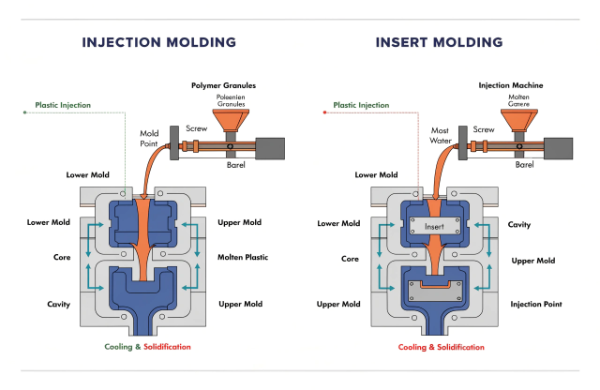
Let's break down the steps to see the impact. In a typical injection molding cycle, speed is key. The machine closes, injects molten plastic, holds pressure while the part cools, and then the mold ejection system pushes out the finished monolithic components. The entire cycle is often fully automated and very fast.
The insert molding cycle introduces a manual or robotic step at the beginning. Before the mold closes, the prefabricated inserts must be loaded into the mold cavity. This extends the molding cycle time slightly for each part. However, this upfront investment in time completely eliminates the need for post-molding assembly. For example, instead of making a plastic handle and then manually screwing in a metal fastener later, insert molding creates the finished part in a single operation. This can dramatically reduce labor costs and improve the part's structural integrity.
When should you choose one over the other?
Are you unsure which mold is right for your project? The application is the most important factor. Using the wrong one can lead to a product that fails or is unnecessarily expensive.
Choose a standard injection mold for high-volume production of simple, single-material plastic parts. Opt for an insert mold when your part needs enhanced strength, electrical conductivity, or integrated features from hybrid materials, which eliminates downstream assembly steps.
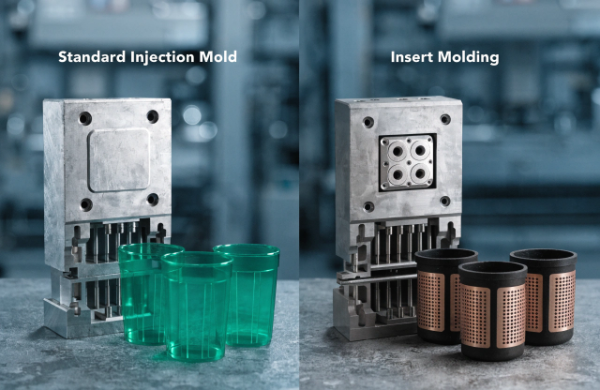
Your choice depends entirely on your product's requirements. Here’s a simple way to think about it.
When to Use an Injection Mold
An injection mold is the go-to solution for mass-producing standalone plastic parts. If your product is made entirely of one type of plastic and doesn't need to be bonded with another material, this is the most cost-effective and efficient method.
- Products: Plastic containers, disposable cutlery, electronic device casings, automotive interior panels.
- Goal: High-speed, low-cost production of uniform monolithic components.
When to Use an Insert Mold
An insert mold is ideal for creating complex composite parts that integrate the properties of different materials. This process is perfect when you need to add strength, wear resistance, or conductivity to a plastic part.
- Products: Screwdrivers with plastic handles over metal shafts, medical devices with embedded sensors, knobs with brass threads, overmolded electrical connectors.
- Goal: Creating robust, multi-functional parts in a single step, avoiding post-molding assembly.
What about the cost of mold tooling?
Worried about the initial investment? An insert mold costs more upfront, but it can actually save you money in the long run by simplifying your entire production workflow.
An injection mold is generally cheaper to design and build due to its simpler construction. An insert mold requires more complex engineering for insert positioning and locking, making its initial mold tooling cost higher. However, this can lower the total manufacturing cost per part.
Let's look at the numbers and the reasoning behind them. The initial cost of mold tooling is a major factor in any project budget. A standard injection mold is focused on one task: shaping plastic. Its design is relatively straightforward.
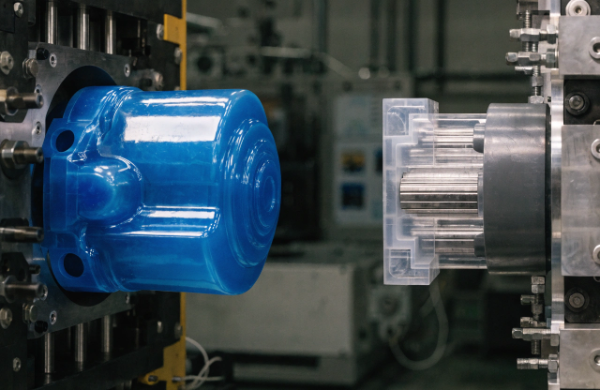
An insert mold is more complex. It needs features to hold the insert securely and prevent it from shifting under the high pressure of the injected molten plastic. This often requires more intricate design work, precision machining, and sometimes specialized mechanisms within the mold itself. These factors increase the upfront cost.
However, you must consider the total cost of production. While the insert mold is more expensive initially, it produces a finished, integrated part. The standard injection mold produces a simple plastic part that may require additional labor and equipment for post-molding assembly. By eliminating these downstream steps, insert molding can significantly reduce labor costs, streamline your supply chain, and result in a more reliable final product, often leading to a lower overall cost per unit.
| Cost Factor | Injection Mold | Insert Mold |
|---|---|---|
| Initial Tooling Cost | Lower | Higher (due to complexity) |
| Molding Cycle Time | Faster | Slower (due to insert loading) |
| Assembly Labor Cost | Potentially High | Zero (assembly is part of the molding process) |
| Total Cost Per Part | Varies | Often Lower for complex composite parts |
Conclusion
In short, choose an injection mold for simple plastic parts. Select an insert mold when you need to combine plastic with other materials for superior strength and integrated functionality.