Are you struggling with long cycle times and inconsistent quality in your injection molding projects? These issues often point to outdated mold technology. 3D printing is now revolutionizing mold inserts.
The main trends in 3D printing for mold inserts are conformal cooling for unmatched efficiency, specialized materials for superior durability, functional integration for smarter molds, and the use of AI with digital twins1 for intelligent production. These advancements are making injection molding faster, more precise, and more reliable.
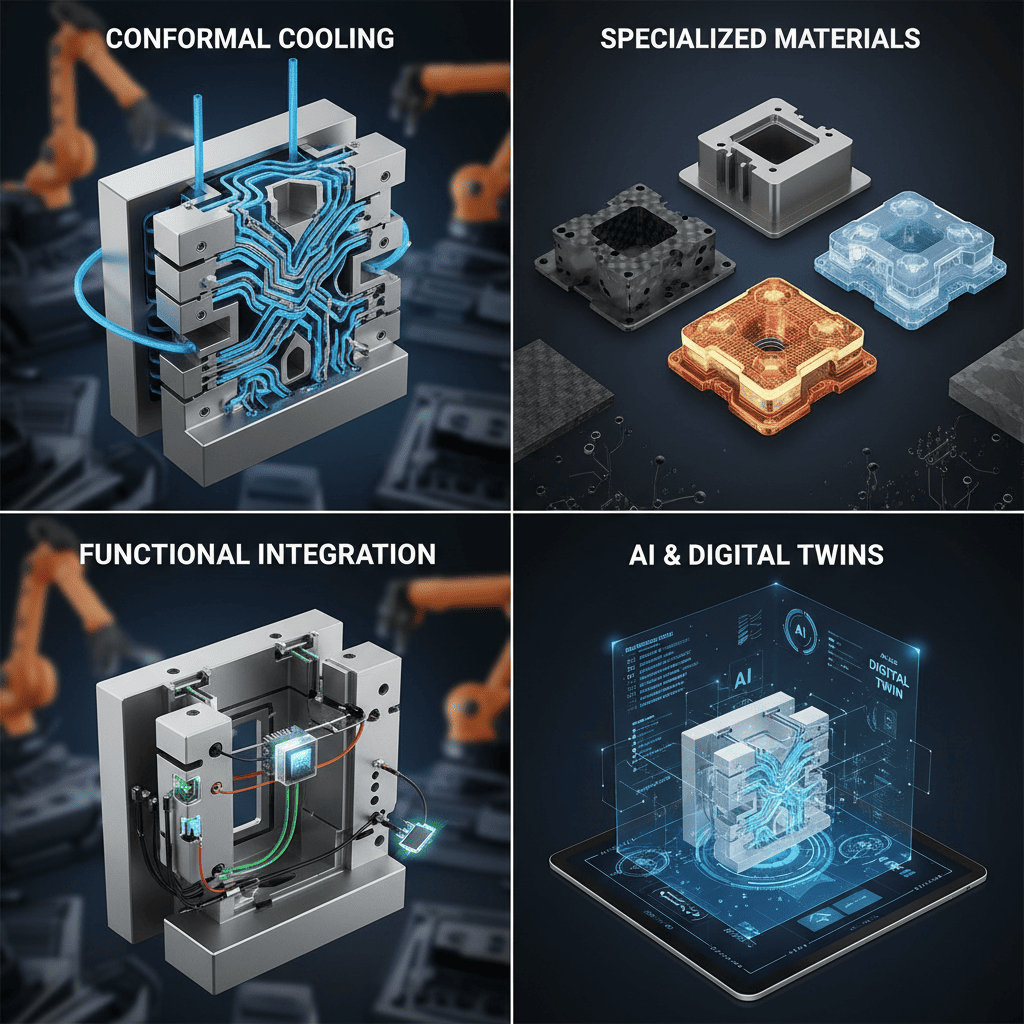
These trends are more than just buzzwords. They represent a fundamental shift in how we approach mold making and production. In my 15 years in this industry, I've seen many technologies come and go, but the changes happening now are truly transformative. Let’s explore each of these trends. I want to show you how they can directly impact your bottom line and product quality. This isn't just about investing in new hardware; it's about adopting a smarter manufacturing mindset.
Can conformal cooling channels really be a game-changer?
Tired of battling part defects like warpage and sink marks? These problems often come from uneven cooling in the mold. 3D-printed conformal cooling channels solve this by ensuring uniform temperature control.
Yes, they are a complete game-changer. Unlike straight-drilled lines, 3D-printed channels follow the exact shape of your part. This provides incredibly uniform and fast cooling. The result is shorter cycle times, better part quality, and a significant reduction in defects, giving you a major competitive edge.
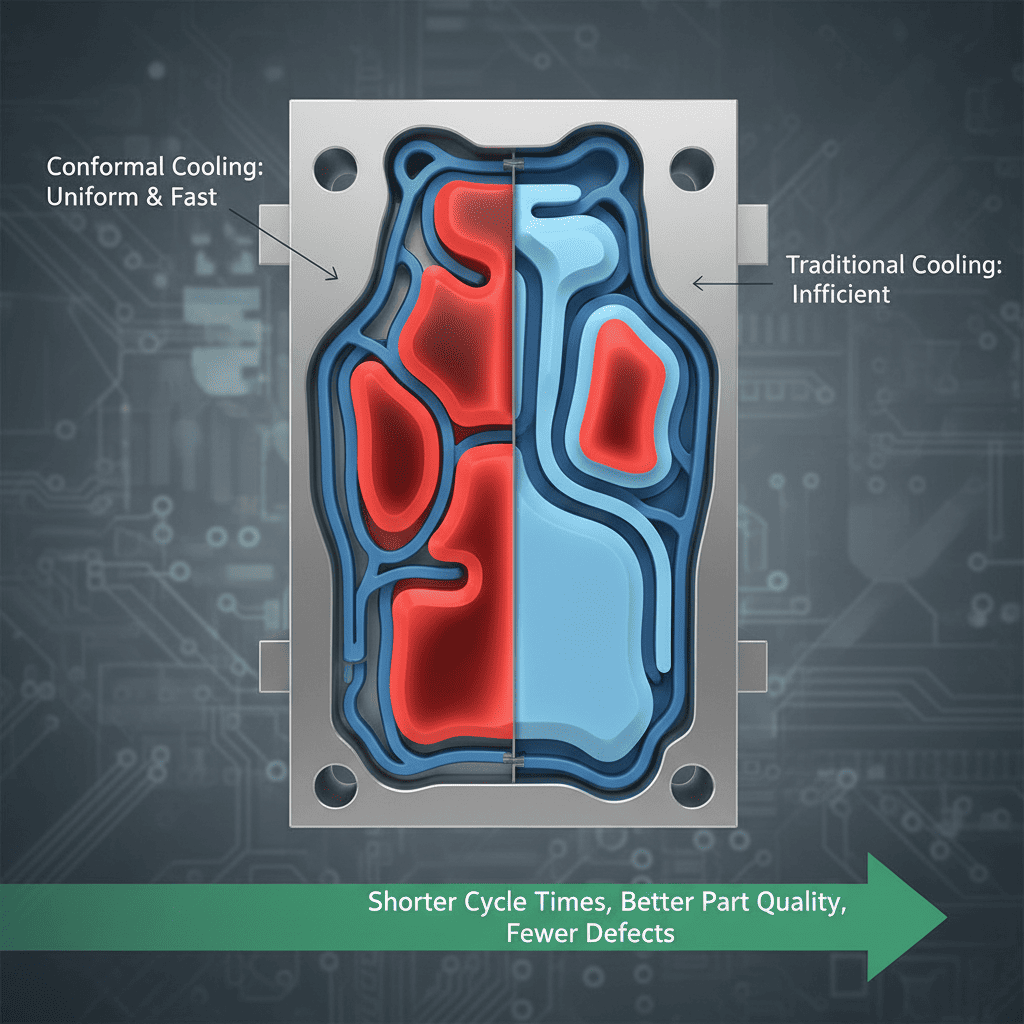
For years, we've had to design around the limitations of traditional cooling. We'd drill straight lines into a block of steel and hope for the best. This method just can't cool complex geometries evenly. With 3D printing, we can forget those limitations. We can design and print cooling channels that hug every curve and corner of the mold cavity. I remember a project for an automotive client where we cut the cycle time by nearly 30% just by redesigning the inserts with conformal cooling.
Deeper Integration is the New Standard
The trend is now moving beyond just conformal cooling. It’s about integrating these channels with other systems.
- Hot Runner Synergy: We're now combining conformal cooling with advanced hot runner systems2. Think of the hot runner as the "temperature manager" for the molten plastic. It can raise the temperature in thin-walled areas to ensure a complete fill and lower it in thick sections to prevent sink marks. When you combine this precise heating with the precise cooling of conformal channels, you get total control over the molding process.
| Feature | Traditional Cooling | Conformal Cooling |
|---|---|---|
| Channel Design | Straight lines, limited by drilling capabilities | Complex, follows part geometry |
| Temperature Control | Uneven, hot and cold spots are common | Highly uniform surface temperature |
| Cycle Time | Longer, due to inefficient heat removal | Shorter, up to 50% reduction in some cases |
| Part Quality | Prone to defects like warpage and sink marks | Significantly improved dimensional stability3 |
This synergy allows us to shorten molding cycles even further while simultaneously improving part quality. It’s a powerful combination that is quickly becoming a core competency for high-end mold manufacturing.
Are new materials driving a revolution in mold performance?
Are your molds wearing out too quickly or struggling with corrosive materials? Standard tool steels have their limits. The constant wear and tear of production demands something better. New, specialized materials are the answer.
Absolutely. Materials science is at the heart of this revolution. Advanced metal alloys and composites designed specifically for 3D printing are creating molds that last longer, resist wear, and even cool faster. This is fundamentally changing what we expect from our tooling in terms of performance and lifespan.
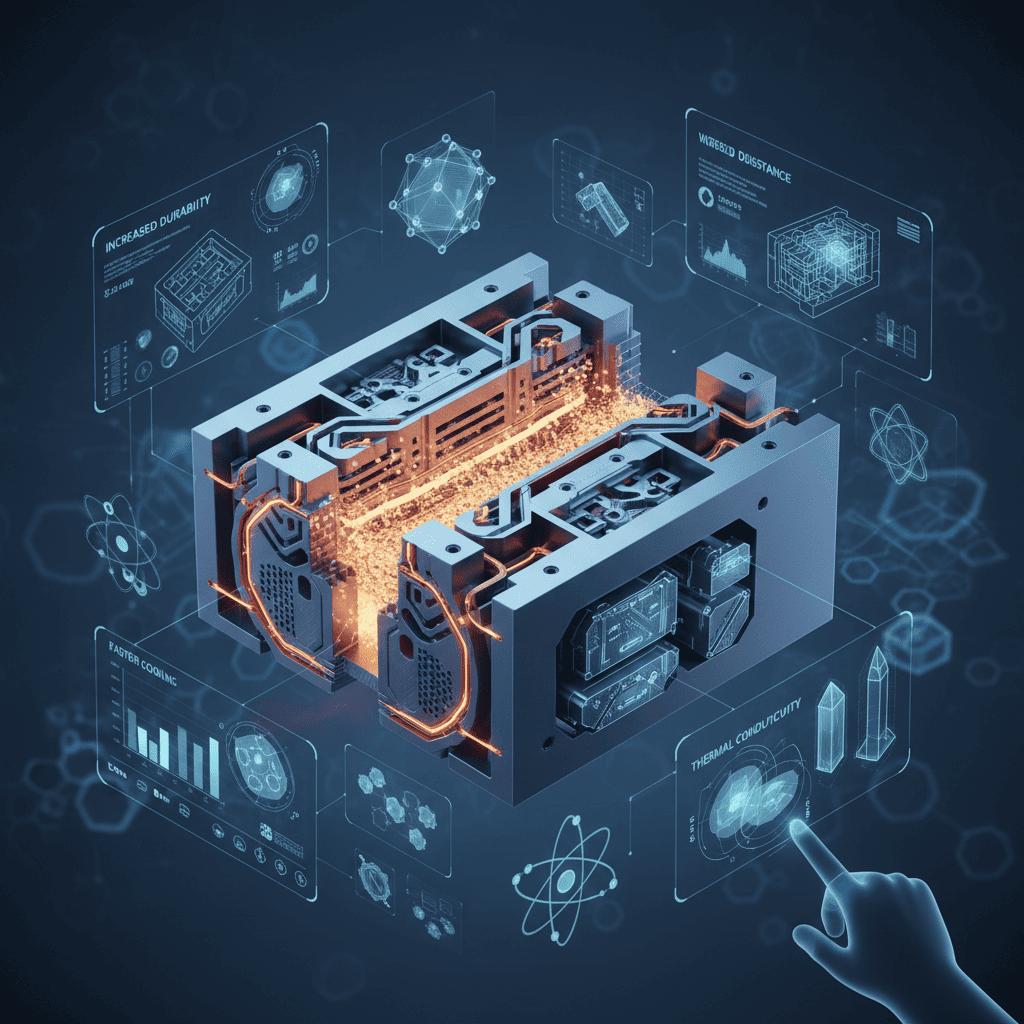
The materials we can now use for 3D-printed inserts are incredible. We're no longer limited to just a few types of steel. This opens up a world of possibilities for creating molds that are perfectly suited for a specific application. As a manufacturer, I'm excited because it means we can deliver tooling that doesn't just work, but excels.
High-Performance Metals and Composites
The development of new materials is a hot topic. They are the physical foundation of 3D printing's success in our industry.
-
Tougher Metal Alloys: To handle the stress of long production runs, new alloys are constantly being developed. For example, high-entropy alloys are becoming popular for precision connector molds due to their amazing combination of strength and wear resistance. We're also seeing nanocrystalline metals that have a fatigue life several times longer than traditional mold materials. This means less maintenance and longer uptime for our clients.
-
Composites and Coatings: It's not just about metals. Non-metal materials are also making an impact. Carbon fiber-reinforced plastic (CFRP) molds are being tested for things like consumer electronic housings. They can't match the lifespan of steel, but they are cheaper and cool down much faster, making them great for prototyping or short runs. We're also applying advanced coatings, like graphene, to the mold surface. This can dramatically improve thermal conductivity, helping to optimize the production cycle even further.
The right material choice can make or break a project. This trend is about having a bigger, better toolbox to choose from.
Can molds become more than just shaping tools?
Do you think of a mold as just a passive tool for shaping plastic? That traditional view is becoming outdated. The complexity of modern products demands more intelligence and functionality built directly into the mold.
Yes, they are evolving into highly integrated "smart engines." With the design freedom of 3D printing, we can now embed complex functional systems directly inside the mold. This transforms it from a simple forming tool into a multi-functional platform that actively improves the manufacturing process.

The idea of a "smart" mold used to sound like science fiction. But we are building them today. By integrating different systems, the mold itself becomes an active participant in ensuring quality and efficiency. It’s no longer just a hunk of steel; it's a sophisticated piece of machinery. This integration is where we can provide huge value, moving beyond simple shaping to active process control.
Building in Functionality and Automation
3D printing gives us the freedom to build in features that were previously impossible. This is leading to molds that are more like automated, intelligent systems.
-
Functional Integration: A mold is no longer just for shaping. We can integrate gas-assist injection molding4 channels right alongside the cooling and hot runner systems. Gas-assist acts as a "shaping helper," using pressurized gas to pack out thick sections. This is incredibly effective at eliminating sink marks and warpage, especially in large or structurally complex parts like those we make for our automotive clients.
-
Intelligent Maintenance: We are also embedding automation to manage the mold's lifecycle. Imagine an automatic cleaning system that periodically removes residue from the mold surface, ensuring consistent product quality. Or an automatic lubrication system that applies grease to moving parts exactly when needed. These features reduce wear, extend the mold's life, and allow for predictive maintenance, preventing breakdowns before they happen.
This level of integration is turning molds into the intelligent heart of the production cell.
How do AI and digital twins create smarter production?
Is your mold design and production process still heavily reliant on trial and error and past experience? While experience is valuable, this approach can be slow and may not lead to the best possible solution.
AI and digital twins bring data-driven intelligence to the entire process. AI-powered generative design automates the optimization of mold layouts for lightweighting and performance. Digital twins create a virtual replica for real-time monitoring, self-adjusting processes, and predictive maintenance, minimizing downtime.
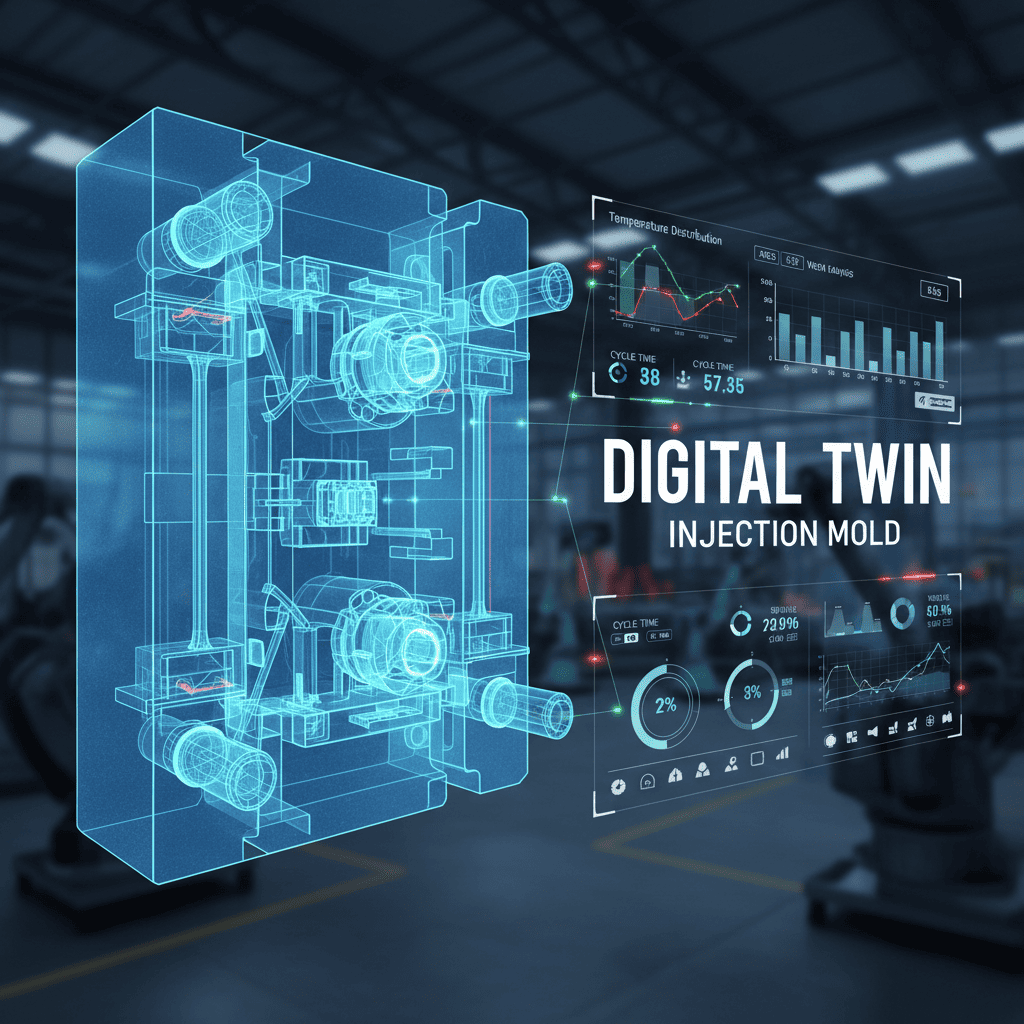
Beyond a mold's physical structure and materials, a new competitive advantage is emerging: data. The "soft" technologies of AI and digital twins are adding a layer of intelligence that we've never had before. This is what it means to move towards Industry 4.0. We're not just making parts; we're analyzing data from the process to make it better, faster, and more reliable.
Intelligent Design and Full-Process Optimization
Data is the new raw material, and these technologies are the tools to refine it.
-
AI-Powered Design: We are using generative design systems that use artificial intelligence to explore thousands of design options. For a mold insert, the AI can automatically optimize the layout of the gating system and cooling channels. It can find a solution that meets all strength requirements while being lighter or cooling more efficiently than a human-designed equivalent. This saves engineering time and often results in a superior final product.
-
Lifecycle Monitoring with Digital Twins: A digital twin is a complete virtual mirror of a physical mold. By equipping the real mold with sensors, we can feed live data into its digital twin. This allows us to monitor the mold's condition and performance throughout its entire life. The system can automatically adjust process parameters in real-time to maintain quality and even predict when a component is about to fail. This allows us to schedule maintenance proactively, virtually eliminating unplanned downtime.
These data-driven tools are elevating 3D-printed molds from simply being well-made to being truly intelligent.
Conclusion
In short, 3D printing is transforming mold inserts through conformal cooling, advanced materials, system integration, and AI. These trends are making molding smarter, faster, and more efficient for everyone.
Find out how AI and digital twins can transform production efficiency and predictive maintenance in manufacturing. ↩
Understand the role of hot runner systems in improving temperature control and part quality during injection molding. ↩
Learn about the importance of dimensional stability and how it impacts the quality of molded parts. ↩
Learn how gas-assist technology can eliminate defects and improve the quality of complex molded parts. ↩