
Struggling with different hardness values from suppliers? Mismatched specs can cause project delays and failures. Here’s how to translate between them easily and ensure your material quality1 is consistent.
To convert between hardness scales like Brinell (BHN)2, Vickers (HV)3, and Rockwell (HRB, HRC)4, you must use a standardized conversion table, like those in ASTM E1405. These tables provide approximate equivalent values, as direct mathematical formulas don't exist due to different testing methods6.


These conversion tables are essential tools in our daily work. But relying on a chart without understanding the context can be risky. The values are approximations, not exact translations. Knowing why they differ is key to making informed decisions for your project. Let's explore what makes each test unique and why conversion is so important.
What are the key differences between these hardness tests?
Confused by Brinell, Vickers, and Rockwell tests? Using the wrong one can give you inaccurate data for your material. Let's clarify which test is suitable for which application.
The main differences are the indenter shape7, the load applied8, and how the hardness value is calculated. Brinell uses a ball indenter, Vickers uses a diamond pyramid, and Rockwell uses either a ball or a diamond cone. This makes each method suitable for different materials.

Understanding these differences is crucial for selecting the right test and interpreting results correctly. I remember a project years ago where a client specified a Rockwell hardness for a very thin part. The test itself damaged the part, giving a false reading. We had to switch to a Vickers test with a much lighter load to get accurate data. This experience taught me that the test method is just as important as the final number. Let's break down the specifics.
Brinell Hardness Test (BHN)
The Brinell test is one of the oldest methods. It uses a 10 mm diameter tungsten carbide ball to make an indentation on the material's surface. It's often used for materials with coarse or inconsistent grain structures, like castings and forgings. Because the indentation is large, it gives a good average reading of the material's overall hardness. However, it's not suitable for very hard materials or thin parts where the indentation could punch through.
Vickers Hardness Test (HV)
The Vickers test uses a diamond pyramid indenter. This method is very versatile because it can be used on a wide range of materials, from soft metals to very hard ones. The diamond shape creates a clear indentation that is measured diagonally. It is especially useful for thin materials and small parts. The downside is that the surface needs to be well-prepared, and the measurement process is slower because it requires optical evaluation.
Rockwell Hardness Test (HRB & HRC)
The Rockwell test is the most common method in the industry because it's fast and simple. It measures the depth of the indentation, not the size. It has multiple scales, with HRB (using a ball indenter) for softer materials and HRC (using a diamond cone) for harder materials like heat-treated steel. The direct readout makes it perfect for quick quality control checks on the production line.
| Feature | Brinell (BHN) | Vickers (HV) | Rockwell (HRB/HRC) |
|---|---|---|---|
| Indenter | 10 mm Carbide Ball | Diamond Pyramid | Diamond Cone (HRC) / Steel Ball (HRB) |
| Measurement | Diameter of Indentation | Diagonals of Indentation | Depth of Indentation |
| Best For | Castings, forgings, soft metals | All metals, thin parts, case hardening | Heat-treated steel, mass production |
| Advantage | Averages out inconsistencies | Very accurate, one scale for all | Fast, easy to use, direct readout |
| Limitation | Not for thin or very hard parts | Slow, requires good surface prep | Multiple scales can be confusing |
Why is hardness conversion so critical for your custom molding project9?
Do you think a hardness number is just a number? A simple mistake in converting values between a blueprint and a supplier's report can lead to complete part failure.
Hardness conversion is critical because it ensures everyone—from the engineer to the material supplier to the quality control team—is working with the same specification. It prevents misunderstandings that can lead to using the wrong material, causing mold damage10 or producing parts that fail under stress.

In custom manufacturing, precision is everything. A client's design might specify a hardness in HRC, but our steel supplier for the mold might provide their material certificate in BHN. Without an accurate conversion, we could be working with assumptions. This could mean the mold steel is too soft, leading to premature wear and tear, or too hard, making it brittle and difficult to machine. This isn't just a technical detail; it's a fundamental part of risk management in any project.
Ensuring Material Consistency
Imagine you are developing a new electronic enclosure. The design calls for a specific grade of steel with a hardness of 55 HRC to ensure durability. You source the material from two different suppliers to manage risk. Supplier A provides test reports in HRC, but Supplier B provides them in Vickers (HV). You need a reliable conversion to confirm that both batches of steel meet your 55 HRC requirement. A quick check on a conversion chart11 shows that 55 HRC is approximately 600 HV. This simple step confirms both materials are consistent, preventing production issues down the line.
Preventing Mold and Part Failure
The hardness of the mold core and cavity steel is directly related to its lifespan and the quality of the plastic parts it produces. If the steel is too soft, it will wear out quickly, especially with abrasive materials like glass-filled nylon. If it's too hard and brittle, it could crack under the high pressure of injection molding. For example, a mold for an automotive part might require P20 steel, typically hardened to around 30 HRC. If a supplier provides it at 280 BHN, we use a conversion table to confirm this is equivalent to about 30 HRC. This verification protects our investment in the mold and ensures the final parts meet the client's standards for strength and performance.
How do you use a hardness conversion table12 correctly?
Have you ever just picked the closest number on a conversion chart11? This can work sometimes, but for high-precision parts, a deeper understanding is needed to avoid critical errors.
To use a hardness conversion table correctly, first identify the material type, as tables are specific (e.g., steel, aluminum). Find your known hardness value in the correct column, then read across the row to find the approximate equivalent value in the desired scale.
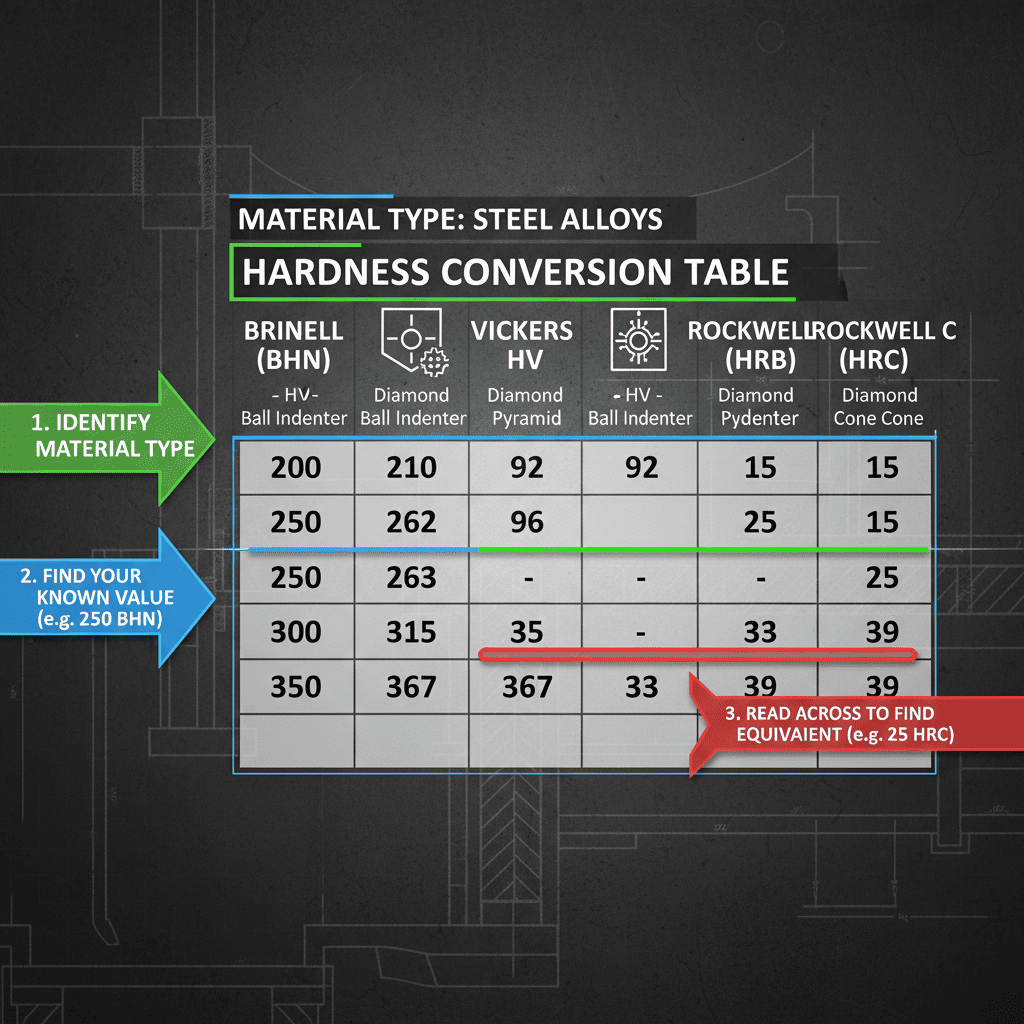
The most important thing to remember is that these charts are based on empirical data, not a perfect mathematical formula. They are a guide, not a law. For a recent medical device project, the material was a special non-ferrous alloy13. The standard steel conversion chart was useless. We had to refer to the specific ASTM E140 table for that alloy family to get a reliable conversion. Using the wrong chart would have resulted in us accepting material that was out of spec.
Step-by-Step Guide to Using a Conversion Table
- Identify Your Material: The first step is to know what material you are working with. Conversion values differ significantly between materials like carbon steel, stainless steel, and non-ferrous metals like brass or aluminum. Always use a table that is specifically made for your material type.
- Locate Your Known Value: Find the column for the hardness scale you already have (e.g., HRC). Go down that column until you find the value from your test report or specification.
- Read Across to the Desired Scale: Once you've found your value, look across that same row to the column of the hardness scale you need to convert to (e.g., BHN). The number in that cell is your approximate converted hardness value.
Common Pitfalls and How to Avoid Them
- Using the Wrong Table: As mentioned, never use a steel chart for an aluminum part. It will give you a completely wrong result. Always double-check that the chart matches your material.
- Converting Outside the Recommended Range: Hardness tests have effective ranges. For example, the HRC scale is not reliable below 20 HRC. If your value is outside the valid range on the chart, the conversion will be inaccurate. In that case, you should physically re-test the material using the appropriate scale.
- Treating Conversions as Exact: Remember that conversions are approximations. If a specification is on the borderline between acceptable and not, a conversion is not enough. The best practice for critical applications is to perform a physical test using the scale required in the specification.
Conclusion
Correctly converting between BHN, HV, and Rockwell scales using the right table is essential for material consistency. This simple step prevents project delays and ensures your final product meets quality standards.
Reference
Understand the importance of material quality in manufacturing processes and its impact on product performance. ↩
Explore this resource to understand the Brinell hardness test, its applications, and how it compares to other hardness tests. ↩
Learn about the Vickers hardness test, its versatility, and why it's suitable for various materials. ↩
Discover the distinctions between HRB and HRC scales in Rockwell testing and their applications in industry. ↩
Understand the significance of ASTM E140 in standardizing hardness conversions across different scales. ↩
Discover various testing methods for measuring material hardness and their specific applications. ↩
Explore how different indenter shapes influence the accuracy and applicability of hardness tests. ↩
Learn about the importance of load in hardness testing and how it impacts the results. ↩
Explore the challenges faced in custom molding projects and how hardness specifications play a role. ↩
Learn about the factors that lead to mold damage and how to prevent it through proper hardness specifications. ↩
Get tips on effectively using hardness conversion charts to ensure accurate material specifications. ↩
Find out how hardness conversion tables function and why they are crucial for material specifications. ↩
Learn about non-ferrous alloys and their unique properties in the context of hardness testing. ↩