跳到内容
跳到内容 

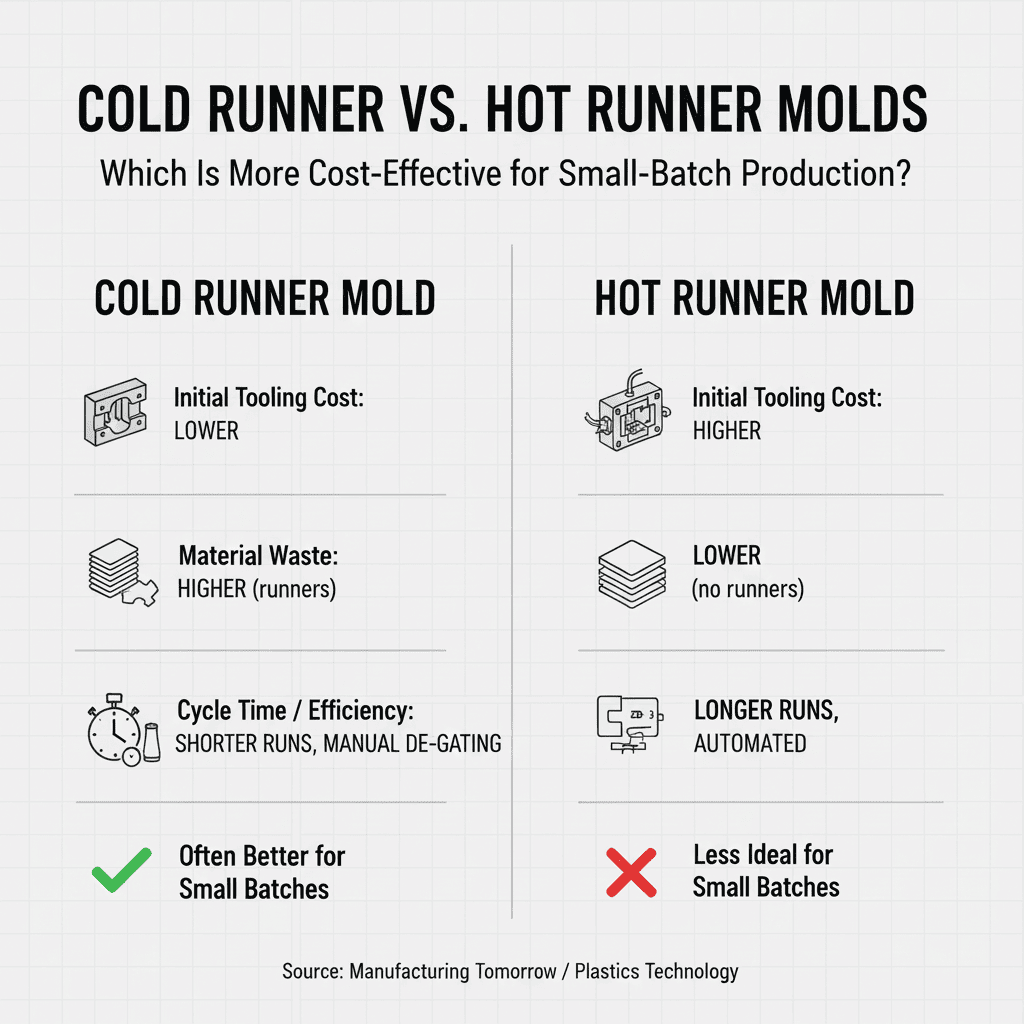
Struggling to choose a mold for your small-batch project? The high upfront cost of a hot runner feels risky, but the material waste from a cold runner seems inefficient.
For small-batch production, cold runner molds are generally more cost-effective. This is due to their significantly lower initial tooling cost, simpler maintenance, and greater flexibility for material and color changes. However, the true cost depends on your specific part's material cost and complexity.

The initial price tag is just the tip of the iceberg. I've seen too many project managers make a decision based on the tooling quote alone, only to face unexpected costs down the line. To really understand which system saves you money, we need to look beyond that first invoice and consider the total cost of bringing your product to life. Let's break down what really matters for a small-batch run.
Is the Upfront Tooling Cost the Only Thing That Matters?
Focusing only on the initial mold price seems smart for a tight budget. But this can be a trap, as hidden costs can secretly eat away at your profits.
No, the upfront tooling cost is not the only factor. While cold runner molds are cheaper to build, hot runner systems can reduce material waste and cycle times. This can potentially lower the cost per part, making the choice less obvious than it first appears.

When we talk about cost, we must look at the Total Cost of Ownership (TCO). This means looking at every expense from the day you order the mold until the last part is shipped. I remember a project for a client developing STEM educational toys. They needed a small batch of 1,000 units for a pilot program. The choice was between a $5,000 cold runner mold and a $15,000 hot runner mold. The decision seemed easy.
The Obvious: Initial Investment
The cold runner mold won on the initial quote, hands down. It's a simpler piece of engineering. It's essentially a block of steel with channels carved into it for the plastic to flow. A hot runner mold, on the other hand, has a complex heated manifold system with nozzles that deliver molten plastic directly into the mold cavities. This complexity—the heaters, thermocouples, and controllers—is what drives the price up. For that STEM toy client, the $10,000 saving was a huge factor.
The Hidden: Cost Per Part
But here's where it gets interesting. The "runner" in a cold runner mold is the solidified plastic left in those channels after each shot. It's waste. For that project, we were using a high-grade, durable ABS plastic that cost a premium. The runner scrap added a noticeable amount to the cost of each part. The hot runner keeps the plastic molten all the way to the part, so there is virtually no waste.
Let's compare them side-by-side:
| Feature | Cold Runner Mold | Hot Runner Mold |
|---|---|---|
| Initial Tooling Cost | Low | High (Often 2-3x) |
| Material Waste | Yes (Runner Scrap) | Minimal to None |
| Cycle Time | Longer (Runner needs to cool) | Shorter |
| Total Cost (1,000 parts) | Lower | Higher |
For their 1,000-unit run, the material waste was a manageable expense, and the cold runner was the right choice. But if they had planned a 50,000-unit run, the material savings and faster production cycles of the hot runner would have easily paid back the higher initial investment.
How Does Project Flexibility Affect Your Choice?
Small-batch projects often mean design changes and material tests. A complex mold can lock you into a path that's expensive to change, creating a production nightmare.
Project flexibility heavily favors cold runner molds for small-batch production. They are much easier and cheaper for changing materials, colors, or even making minor design modifications. This adaptability reduces the financial risk associated with the trial-and-error phase common in new product development.

In my 15 years in this business, I’ve learned that small-batch production is rarely a straight line. It's a process of discovery. You might find that the color you chose doesn't look right, or that a slightly different polymer gives the product a better feel. Your ability to pivot without breaking the bank is a massive competitive advantage.
The Ease of Changing Your Mind
This is where the simplicity of a cold runner is a huge benefit. Let's say you want to change from blue ABS to red ABS. With a cold runner mold, the process is straightforward. We purge the old material out of the injection molding machine's barrel, load the new material, and we're ready to go in a relatively short amount of time. The downtime is minimal.
Now, try that with a hot runner system. The manifold and nozzles are filled with molten plastic. A simple color change requires a lengthy and meticulous purging process to get every last bit of the old color out. If the materials are different (e.g., ABS to PP), it can be even more complicated due to different processing temperatures. This means more downtime, more wasted material during the purge, and higher labor costs.
Trial and Error: The Reality of Small Batches
Small batches are often used for market testing or initial product launches. The goal is to learn and adapt. Cold runners support this goal perfectly.
| Action | Cold Runner Impact | Hot Runner Impact |
|---|---|---|
| Color Change | Fast, minimal downtime | Slow, complex purge, more downtime |
| Material Testing | Simple and low-cost | Complex, requires temperature recalibration |
| Minor Design Tweak | Easier to modify the tool | Can be difficult due to manifold integration |
For a company developing a new line of cosmetic packaging, we used a cold runner mold for their first 5,000 units. They tested three different shades of plastic and two different materials to find the perfect combination of look and feel. The ability to make these changes quickly and cheaply was crucial. A hot runner would have added thousands of dollars and weeks to their development timeline.
Are There Technical Risks to Consider?
You're worried about getting a perfect part every time. But the advanced tech in a hot runner mold can introduce new problems, especially when you don't have a dedicated expert on hand.
Yes, hot runner systems introduce significant technical risks, especially for small-batch producers. Their complexity requires specialized maintenance and troubleshooting skills. A simple failure, like a burnt-out heater, can halt production and lead to costly repairs, posing a larger risk than the simpler, more robust cold runner mold.

I always tell my clients that the best technology is the one you can manage effectively. A hot runner mold is a sophisticated piece of equipment. When it works, it's brilliant. When it doesn't, it can become a major headache, what I call "technical debt."
The Maintenance Burden
A cold runner mold is mostly a solid block of steel. Its maintenance is simple: keep it clean, ensure the ejector pins are lubricated, and store it properly. Almost any decent tool shop can service it. A hot runner, however, has a delicate nervous system of wires, thermocouples, and heating elements.
- Heater Failure: If a single heating element in the manifold burns out, it can create cold spots, leading to cosmetic defects or incomplete parts. Replacing it requires disassembling the mold, which is a specialized job.
- Gate Drooling: If the temperature at the nozzle tip isn't perfectly controlled, you can get "drooling" or "stringing," which ruins the part's appearance and can jam the mold.
- Specialized Knowledge: Troubleshooting these issues requires an operator with a deep understanding of hot runner systems. This isn't a skill everyone has, especially in smaller shops.
When Simplicity Equals Reliability
For small-batch production, reliability is often more valuable than peak efficiency. You need the machine to run consistently for a short period to get your parts. You don't have the volume to justify a full-time hot runner specialist. The cold runner is predictable. It will produce a runner every time, and you know you have to deal with that scrap. But it's far less likely to shut down your entire production run because of a complex electronic failure. The risk of unexpected downtime and expensive repairs is much, much lower. This is a hidden cost-saving that many people overlook when they're mesmerized by the promise of zero waste and fast cycles.
Conclusion
For small-batch production, the cold runner mold is often the more cost-effective and practical choice due to its lower initial cost, flexibility, and simpler maintenance, despite its material waste.